
Overview
If you’re new to the AR-15 platform—or even if you’ve owned one for years—magazine capacity is one of the most commonly misunderstood topics. Walk into a range or browse online forums, and you’ll hear conflicting opinions about what capacity is “standard,” what’s legal, and what actually makes sense for different situations. In 2026, with changing state regulations, evolving range rules, and more focus on responsible firearm ownership, understanding AR-15 magazine capacity matters more than ever.
At its core, magazine capacity affects how often you reload, how your rifle handles, and whether you remain compliant with local laws. Yet many people assume capacity is about firepower alone, which oversimplifies the reality. Capacity choices are often driven by ergonomics, training goals, competition rules, hunting regulations, or legal limits—rather than preference alone.
This guide explains AR-15 magazine capacity from every practical angle. We’ll break down standard and high-capacity sizes, explain how capacity affects performance, clarify legal considerations in the United States, and help you choose the right option for your specific use—without hype, politics, or sales pressure. The goal is simple: give you clear, updated information so you can make informed, responsible decisions.
What Does AR-15 Magazine Capacity Actually Mean?
AR-15 magazine capacity refers to the number of cartridges a magazine is designed to hold. It does not change how the rifle functions, how quickly it fires, or whether it is semi-automatic. Capacity simply determines how many rounds are available before a reload is required.
A helpful way to think about it is like a fuel tank in a vehicle. A larger tank lets you travel farther before refueling, but it doesn’t make the engine faster. In the same way, a higher-capacity magazine reduces reload frequency, but it does not increase the firing rate or mechanical capability of the rifle.
Another common misunderstanding is that capacity equals size. While capacity and physical length are related, two magazines of the same length can sometimes hold different numbers of rounds depending on design, follower shape, and internal geometry. Capacity is about internal design, not just appearance.
Understanding this distinction is important, especially for new owners, because many rules—both legal and at shooting ranges—are written specifically around capacity limits, not magazine dimensions or materials.
Standard AR-15 Magazine Capacities Explained
There is no single capacity that fits every situation, but several sizes are widely recognized as “standard” based on use and availability.
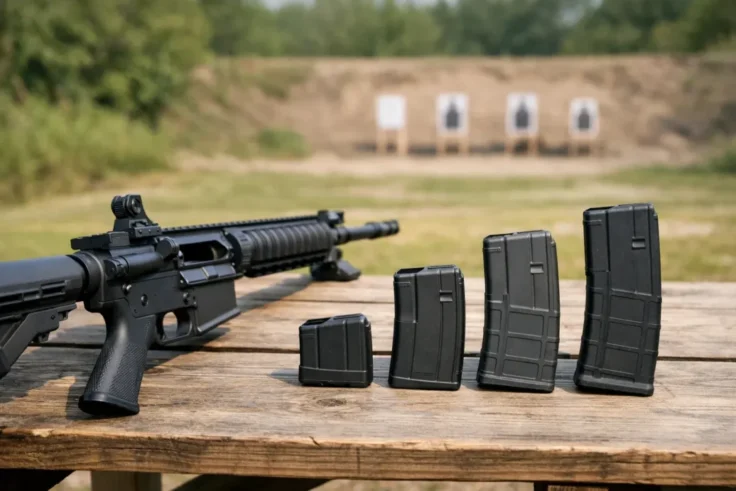
5-Round Magazines
Five-round magazines are most commonly associated with hunting and specific compliance requirements. Many hunting regulations limit magazine capacity to ensure ethical harvesting and controlled shot placement. These magazines are also useful for bench shooting and slow-fire practice, where frequent reloads are not a drawback.
10-Round Magazines
Ten-round magazines are popular in states with capacity restrictions and at ranges that impose round limits for safety or training reasons. They are compact, lightweight, and easy to manage, making them a common choice for beginners who want to focus on fundamentals like stance and trigger control.
20-Round Magazines
Twenty-round magazines offer a balance between capacity and handling. They are shorter than 30-round magazines, which can make shooting from a bench or prone position more comfortable. Many shooters appreciate the reduced weight without sacrificing too much capacity.
30-Round Magazines
In most unrestricted states, 30 rounds is widely considered the standard AR-15 magazine capacity. This size became common due to widespread availability, balanced ergonomics, and long-term industry adoption. It offers a practical middle ground between reload frequency and manageable weight, which is why it’s so commonly seen at ranges and training courses.
High-Capacity AR-15 Magazines: What Counts as High Capacity?
The term “high capacity” does not have a single universal definition. In practical use, it usually refers to magazines holding more than 30 rounds, such as 40-round magazines, extended 60-round magazines, or drum magazines.
These options are typically chosen for specific purposes rather than everyday use. Larger capacities reduce reload frequency but introduce trade-offs. As capacity increases, magazines become heavier and longer, which can affect balance and fatigue during extended sessions. Some high-capacity designs also require more careful maintenance to ensure reliable feeding.
It’s important to separate myths from reality. High-capacity magazines do not inherently make a rifle more accurate or less accurate, and they do not change the mechanical operation of the firearm. Their usefulness depends entirely on the context in which they’re used and whether they are permitted by law and range rules.
How Magazine Capacity Affects AR-15 Performance
Magazine capacity plays a subtle but real role in how an AR-15 feels and performs during use.
Higher-capacity magazines reduce how often you reload, which can be helpful in structured training or competition settings. However, added weight can change the rifle’s balance, particularly when shooting offhand. This can lead to quicker fatigue over long sessions.
Lower-capacity magazines are lighter and often improve balance, especially for newer shooters. They also encourage more frequent reload practice, which can be beneficial for skill development.
Reliability is another factor. Well-designed magazines of any capacity can be reliable, but higher-capacity designs place more demand on springs and followers. Proper maintenance becomes more important as capacity increases.
In short, capacity affects handling and endurance, not mechanical accuracy or firing capability.
AR-15 Magazine Capacity Laws in the United States (2026 Update)
Magazine capacity laws in the U.S. vary by state and are subject to change. Some states restrict magazines to 10, 15, or 20 rounds, while others have no capacity limits at all. These laws may apply to possession, sale, or transfer and can differ for residents and visitors.
It’s also important to understand that range rules and competition regulations can be more restrictive than state law. A magazine that is legal to own may still be limited in certain environments.
Because laws evolve, responsible owners should always verify current regulations through official state sources or legal counsel. This guide provides general information, not legal advice. Staying informed is part of safe and lawful firearm ownership.
Choosing the Right AR-15 Magazine Capacity for Your Use
The best capacity depends on how you plan to use your AR-15.
Range Training
Many ranges limit loaded rounds for safety and flow. Ten- or twenty-round magazines are often practical and convenient.
Home Defense (General Information)
From an informational standpoint, capacity decisions should consider reliability, handling, and legal compliance. Simplicity and familiarity are often prioritized over maximum capacity.
Hunting
Hunting laws frequently impose strict capacity limits. Five-round magazines are commonly used and widely accepted.
Competition Shooting
Competition rules dictate allowable capacities. Shooters often choose magazines that align precisely with match requirements to avoid penalties.
New Owners
Lower-capacity magazines can help new owners focus on fundamentals without added weight or complexity.
Pros and Cons of Different AR-15 Magazine Capacities
Low Capacity (5–10 rounds)
Pros: Lightweight, compliant, easy handling
Cons: Frequent reloads
Standard Capacity (20–30 rounds)
Pros: Balanced weight, widely available, versatile
Cons: Heavier than low-capacity options
High Capacity (40+ rounds)
Pros: Fewer reloads
Cons: Added weight, potential reliability considerations, legal limits
Common AR-15 Magazine Capacity Myths (Debunked)
One common myth is that higher capacity automatically reduces accuracy. In reality, accuracy depends on the shooter, ammunition, and rifle—not magazine size. Another misconception is that 30-round magazines are illegal everywhere, which is not true, as legality depends on state law. Finally, many believe keeping magazines loaded damages them, but quality magazines are designed to handle proper loading when maintained correctly.
Magazine Capacity Mistakes New AR-15 Owners Make
New owners sometimes purchase magazines without checking state laws, leading to compliance issues. Others choose capacity based on assumption rather than use, ending up with magazines that don’t suit their shooting style. Poor storage and lack of maintenance are also common mistakes that affect long-term reliability.
Future Trends in AR-15 Magazine Capacity (2026 & Beyond)
Looking ahead, manufacturers are focusing more on compliance-friendly designs, improved materials, and reliability rather than extreme capacity. Training-oriented shooters are increasingly choosing capacities that support skill development, while innovation continues in lightweight construction and durability.
Frequently Asked Questions (FAQ)
What is the standard AR-15 magazine capacity?
In most unrestricted states, 30 rounds is commonly considered standard.
Are high-capacity magazines legal in all states?
No. Laws vary by state and can change over time.
Does magazine capacity affect accuracy?
No. Accuracy is influenced by the shooter and equipment quality, not capacity.
Can AR-15 magazines be limited or pinned?
Yes. Some magazines are permanently modified to comply with capacity laws.
Is a 30-round magazine too much for beginners?
Not necessarily, but many beginners prefer lower capacities for ease of handling.
Conclusion: Understanding AR-15 Magazine Capacity Responsibly
AR-15 magazine capacity is not about extremes—it’s about choosing what fits your needs, skills, and legal environment. From five-round hunting magazines to standard 30-round options and beyond, each capacity serves a purpose when used responsibly.
By understanding how capacity affects handling, performance, and compliance, you can make informed decisions that align with your goals and local regulations. In a landscape where laws and best practices continue to evolve, staying educated is the most important step toward responsible ownership.
About the Author